OSRS F2P Melee AFK Training: Giant Spiders vs Moss Giants Guide
11 October 2026 · 14 min readA realistic free-to-play melee training guide comparing giant spiders and moss giants for AFK experience. Includes best weapons, food sustain, time-to-goal, and when buying gold or a boost is the honest shortcut.
Game screenshots and facts are cited from the Old School RuneScape Wiki (strategy, equipment, drops, and related pages). Writing is original editorial, not a copy of the wiki article.
Contents
- Who This Is For & Requirements
- Why AFK Melee Works in F2P
- Giant Spiders: The AFK Experience Playground
- Moss Giants: The Loot and XP Alternative
- Head-to-Head: Giant Spiders vs Moss Giants
- Gear and Food Sustain for No-Prayer AFK Melee
- Time-to-Goal: Honest XP Rates and Leveling Math
- Common Mistakes That Kill Your AFK XP
- When Buying Gold or a Boost Is the Honest Shortcut
Free-to-play melee training often becomes a question of attention: can you make meaningful progress while watching a video, working, or playing another account? Giant spiders and moss giants are two of the most commonly named AFK targets in F2P, but they are not interchangeable. The first offers low-resource, nearly brainless combat; the second layers in better loot and prayer training at the cost of more food and slightly less relaxed rhythm. This guide walks through the realistic tradeoffs, the gear choices that matter, and when buying gold or a boost is the honest answer to a grind that can stretch for hundreds of hours.

We are writing from the Flash Services editorial desk, which means we can talk openly about the marketplace side. Nothing here suggests breaking the rules or using automation. It is about matching your time budget to your account goals. All in-game facts are from the Old School RuneScape Wiki, and anything not listed there should be verified before you commit your evening to a training spot.

Who This Is For & Requirements
This guide assumes you already have base melee stats in the 40s or are willing to get them quickly using the early monsters on the wiki training guide. If you are a fresh level 3, you are better off starting with chickens, monks, seagulls, and giant rats until you can wear rune equipment and hold your own against monsters with higher max hits.
- 40 Attack, 40 Strength, 40 Defence (or at least 40 Attack and Strength, with Defence in the 30s if you bring more food)
- Rune scimitar or the best scimitar you can equip
- Full melee armour against melee attackers, or ranged armour against magic users — check the monster's attack style
- Food: jugs of wine are cheap, but lobsters or swordfish are more forgiving if your Defence is low
- An amulet of strength or amulet of power depending on whether strength increases your max hit
Free-to-play melee training is accessible, but the gap between “can kill” and “can AFK kill” is mostly food sustain and defence. Monsters that hit 1s and 2s let you look away for minutes; monsters that hit 6s and 7s force you to eat more often, which is the opposite of AFK.
Why AFK Melee Works in F2P
The core of an AFK melee setup is simple: use the fastest weapon with the highest strength bonus available, stand next to aggressive monsters, and let auto-retaliate do the work. For free-to-play, that weapon is always the best scimitar you can equip. The wiki training guide makes this explicit: scimitars offer the highest damage per second because of their attack speed and strength bonus. Rune scimitar is the endgame F2P choice at 40 Attack, and no other F2P weapon consistently beats it for melee training, although the barronite mace and rune sword are alternatives for specific accounts or preferences.
Amulet choice is more nuanced than most players think. The amulet of strength adds +10 melee strength bonus, while the amulet of power adds +6 melee strength plus accuracy and defence. If the extra 4 strength bonus does not increase your max hit, the amulet of power is strictly better due to accuracy. The wiki hosts a complete rune scimitar max hit table for strength levels 1–99, including aggressive and non-aggressive styles. You should consult that table at your current Strength level. For example, at 31 Strength, the amulet of strength only raises your max hit from 7 to 8 when using the aggressive style; if you are training Defence or controlled, both amulets give the same max hit, so the amulet of power is better offensively and defensively.
Without prayer flicking, your only sustain is food. The training guide recommends jugs of wine as a cheap food option. They are light and inexpensive enough to bring a full inventory, and their healing is sufficient for low-damage monsters like giant spiders. For higher-hitting monsters like moss giants, you may want lobsters or swordfish to reduce the number of eating animations, which interrupt attack cycles and lower XP per hour.
Giant Spiders: The AFK Experience Playground
Giant spiders are often the first true AFK melee target for free-to-play accounts. They are aggressive, meaning they will attack you without input as long as you are in their aggression range, and they have relatively low max hits for their combat level. This combination means you can stand in one spot, keep auto-retaliate on, and only click to eat or to re-aggro after the aggression timer forces them to ignore you.
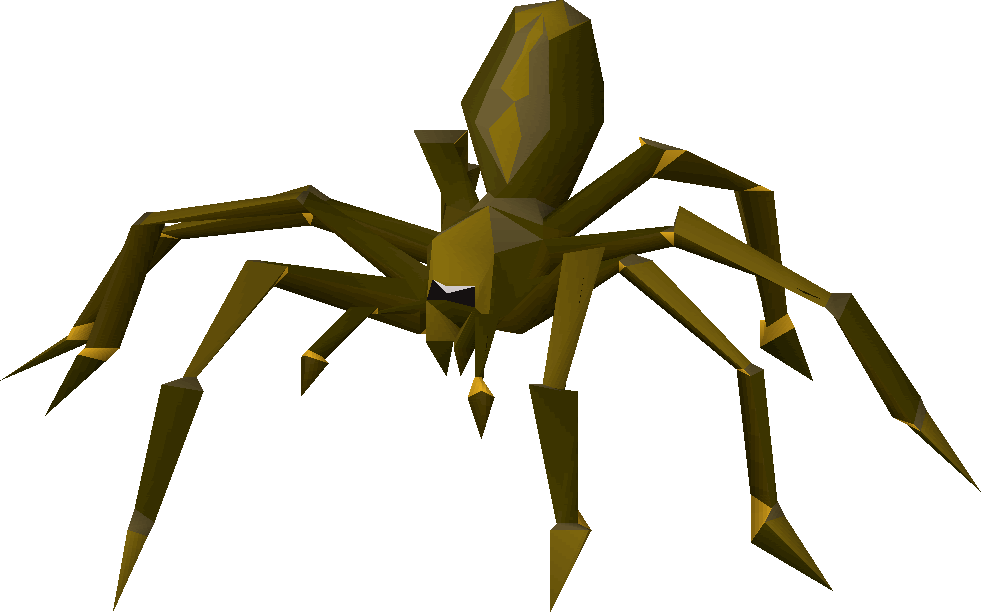
The exact location and requirements for the high-level giant spiders are on the wiki's Giant spider page. Players should verify the current spawns before heading out, as some variants are too low level to be worth your time. The image above shows a low-level giant spider; do not mistake it for the level 50 version that gives meaningful XP at 50+ melee.
Food sustain at giant spiders is minimal. Because their max hit is low, even mid-level Defence and rune armour will keep you alive for long stretches. You can fill your inventory with cheap food and realistically stay for 10–20 minutes per trip depending on your Defence and Hitpoints level. That is the essence of AFK: you glance over, eat twice, and go back to what you were doing.
One common mistake is forgetting that aggression eventually stops. After a certain number of minutes, monsters stop attacking you automatically. You need to move far enough away and return, or hop worlds, to reset the aggression. This is true for giant spiders and many aggressive training spots. The wiki training guide does not list the exact timer, so test it in-game and plan your check-ins around that cycle.
Moss Giants: The Loot and XP Alternative
Moss giants are the step up when you want more than just XP. They are higher level and have more Hitpoints, so each kill takes longer but awards more melee XP per kill. The bigger draw is loot: moss giants drop big bones consistently, which can be banked for Prayer training or sold. The F2P melee training guide explicitly notes that for non-ironman players, selling resources and buying vile ashes for Prayer training is better than burying big bones, so moss giant kills become an indirect Prayer training method as well.
Because moss giants hit harder, the AFK factor drops. You will eat more often, which means more clicks and more interruptions to your attack cycle. However, if your Defence is 50+ with full rune, you can still manage a relatively relaxed session — just not quite as lazy as at giant spiders. The locations and exact combat stats for moss giants are not included in the specific training guide section provided here, so consult the OSRS Wiki Moss giant page for current spawns and drop rates before you commit a long session.
Moss giants also offer the psychological benefit of visible loot. Even if the GP per hour is modest, seeing big bones and occasional rune drops stack up makes the grind feel less monotonous. If you are training to afford better gear, this matters. If you already have your endgame gear and just want XP, the loot is less relevant.
Head-to-Head: Giant Spiders vs Moss Giants
The table below summarises the practical differences without inventing XP rates. XP per hour depends on your max hit, kill speed, and how often you have to eat, so always measure your own rates over a 15-minute session rather than trusting a single number.
| Factor | Giant Spiders | Moss Giants |
|---|---|---|
| Attention needed | Very low; eat rarely, re-aggro occasionally | Low to moderate; eat more often |
| Food sustain | Cheap food works; jugs of wine fine | Better food recommended; lobsters or swordfish |
| Loot | Minimal; check wiki for drops | Big bones, occasional rune items (verify rates) |
| XP per kill | Lower due to lower HP | Higher due to higher HP |
| Kill speed | Fast, low defence | Slower, higher defence |
| Best for | Pure AFK XP; Strength or Attack training while distracted | AFK with loot; indirect Prayer training via bones |
Neither monster is objectively better. If you are watching a movie and want zero thought, giant spiders win. If you are willing to glance over every 30 seconds to eat and pick up bones, moss giants offer a tangible reward that can fund your next gear upgrade or Prayer levels.
Gear and Food Sustain for No-Prayer AFK Melee
Your gear decisions have a direct impact on how long you can AFK. Start with the weapon: the best scimitar you can equip is non-negotiable for efficient XP. At level 40 Attack, that is the rune scimitar. The barronite mace is an alternative for accounts that prefer crush, but for general training the scimitar's speed wins. Rune sword is slightly worse DPS in most AFK scenarios, according to the equipment choice guidance.
Next, the amulet. The wiki's rune scimitar max hit table is your best friend. Here is a simple decision rule:
- If the amulet of strength increases your current max hit in your chosen attack style, use it.
- If it does not increase your max hit, use the amulet of power for its accuracy and defence.
- Remember that aggressive style adds an invisible +3 Strength boost, so the amulet of strength may only be worth it when training Strength aggressively.
For armour, the wiki training guide says to use full melee armour against monsters that attack with melee, and ranged armour against monsters that use magic. Giant spiders and moss giants both use melee, so melee armour is correct. If you need more crush defence for a specific monster, a chainbody provides more crush defence than a platebody, but for these two training targets the difference is rarely decisive.
Boots and gloves are free upgrades many players miss. Any boots awarded in the Stronghold of Security are excellent choices for F2P melee; fancy or fighting boots are easy to reclaim if you die. Decorative boots from Castle Wars provide an extra strength bonus or defence, but the time investment is not worth it if your goal is simply 99 melee — this is explicitly stated in the training guide. For gloves, gilded d'hide vambraces are best-in-slot but require 40 Ranged and are expensive; a cheaper alternative is green d'hide vambraces, and leather gloves work until then. Capes are simpler: all coloured capes, team capes, and the cabbage cape share the same defence bonus and are best-in-slot for F2P players.
Food sustain is the other half of AFK. Jugs of wine are cheap and sufficient at giant spiders. For moss giants, consider lobsters or swordfish to avoid eating every few seconds. Always bring a full inventory, and if you are using a combat style that trains Defence, you can usually get away with lower healing because you take less damage over time.
Time-to-Goal: Honest XP Rates and Leveling Math
We deliberately avoid printing a single XP/hr number because the research pack does not provide one, and rates vary wildly with your gear, attention, and ping. What the wiki training guide does provide is a progression path: levels 1–20 at chickens, monks, seagulls, and giant rats; levels 20–40 at barbarians, big frogs, and giant frogs. For levels 40–60 and 60–99, the guide suggests higher HP monsters — and this is where giant spiders and moss giants typically enter the rotation. Check the exact bracket on the Free-to-play Melee training page to see which monster is recommended for your current stats.
The important honest math is this: free-to-play melee training to 99 is a multi-hundred-hour project. Even at a respectable 40k XP/hr, you are looking at over 300 hours for a single 99, and Attack, Strength, and Defence each need their own grind or shared XP via controlled style. If your goal is a maxed melee account in F2P, you are signing up for a long-term relationship. The wiki also lists Brutus as a viable training method from level 20 to 99 for those who want an alternative, but Brutus is a separate topic and requires its own preparation.
Gold can partially shorten the early pain. Buying a rune scimitar, amulet of power, and a stack of food costs very little compared to the time you would spend earning that GP through low-level killing. But beyond rune, F2P gear has a hard ceiling. That is where a boosting service becomes an honest option: you are trading real-world money for the in-game hours you would otherwise spend clicking a spider.
Common Mistakes That Kill Your AFK XP
- Using the wrong attack style. If you want Strength XP, use aggressive; if you want Defence, use defensive; if you want balanced, use controlled. Leaving it on accurate when you meant to train Strength wastes hours.
- Forgetting to re-aggro. Aggressive monsters stop attacking after a timer. If you are not looking, your character will stand there doing nothing. Set a mental check-in interval.
- Wearing the wrong amulet. Using amulet of strength when it does not increase your max hit is a pure loss of accuracy compared to amulet of power.
- Bringing too little food. Running out of food forces you to leave early or die. At giant spiders you can under-pack, but at moss giants bring a full inventory of decent food.
- Using a platebody when chainbody is better for crush defence. This rarely matters for spiders or moss giants, but it is a general F2P melee note from the equipment guide — check the monster's attack style.
- Not banking bones or drops. At moss giants, big bones are either profit or Prayer XP. Letting them despawn because you are too AFK is a missed opportunity.
- Thinking a boost or gold purchase is a waste. If you value your time at more than a few GP per hour of grind, buying supplies is often the rational choice.
When Buying Gold or a Boost Is the Honest Shortcut
Flash Services exists because not everyone has 300 hours to click giant spiders. Buying gold to afford your rune scimitar, amulet, and a few thousand lobsters is a minor real-world expense that saves you the early money-making grind. Gold is also useful for funding Prayer training: the F2P melee guide recommends selling big bones and buying vile ashes instead of burying them, so a small gold injection can speed up your Prayer levels alongside melee.
Account boosting is a different tier. Handing over your account to a professional service is against Jagex's rules if it involves account sharing, and we cannot claim otherwise. However, many players use trusted services to complete the monotonous melee hours while they sleep or work. That decision is yours to make; just know the risks. We are not here to tell you to break rules, but we are also not going to pretend the grind is fun for everyone.
If you decide to buy gold, use a reputable marketplace. Flash Services offers live gold rates that update with the market, so you can budget exactly what a rune scimitar or a week of food costs. The link below takes you to our gold market.

Sources
What are the best F2P monsters for AFK melee training?
Giant spiders and moss giants are two popular choices. Giant spiders require very little attention and cheap food, while moss giants offer big bones and occasional rune drops. The best monster depends on whether you prioritise raw XP or loot. The wiki's Free-to-play Melee training page lists other options by level bracket.
Are giant spiders better than moss giants for AFK XP?
For pure AFK, giant spiders are generally better because they hit lower and let you look away longer. Moss giants hit harder, forcing more frequent eating and reducing true AFK time. However, moss giants give more XP per kill and better loot, so they are better if you can spare a little attention.
What weapon should I use for F2P melee training?
Always use the best scimitar you can equip. At 40 Attack that is the rune scimitar, which offers the highest damage per second in F2P melee. The barronite mace and rune sword are alternatives, but the scimitar's speed and strength bonus make it the default choice for efficient AFK training.
How much food do I need for giant spiders vs moss giants?
Giant spiders can be sustained with cheap food like jugs of wine and a full inventory will often last 10–20 minutes. Moss giants hit harder, so lobsters or swordfish are recommended, and you may need to bank more frequently. Your Defence level and armour also affect trip length.
Can I train melee without prayer flicking in F2P?
Yes. Prayer flicking is entirely optional. For AFK training, you can rely on food, armour, and aggressive monsters. The key is choosing monsters with low max hits, like giant spiders, and using the correct attack style. This guide focuses on no-flick methods that stay relaxed.
What is the best amulet for F2P melee AFK training?
Use an amulet of strength if it raises your max hit in your current attack style. If it does not, the amulet of power is better due to its accuracy and defence bonuses. Check the rune scimitar max hit table on the OSRS Wiki to see breakpoints for your Strength level.
Should I buy gold to fund my F2P melee training?
Buying gold is a time-saving option. A small purchase can cover a rune scimitar, amulet, and a large food supply, letting you skip early money-making. It cannot buy XP directly, and account boosting has separate risks, but for gearing up, gold is an honest shortcut many players use.